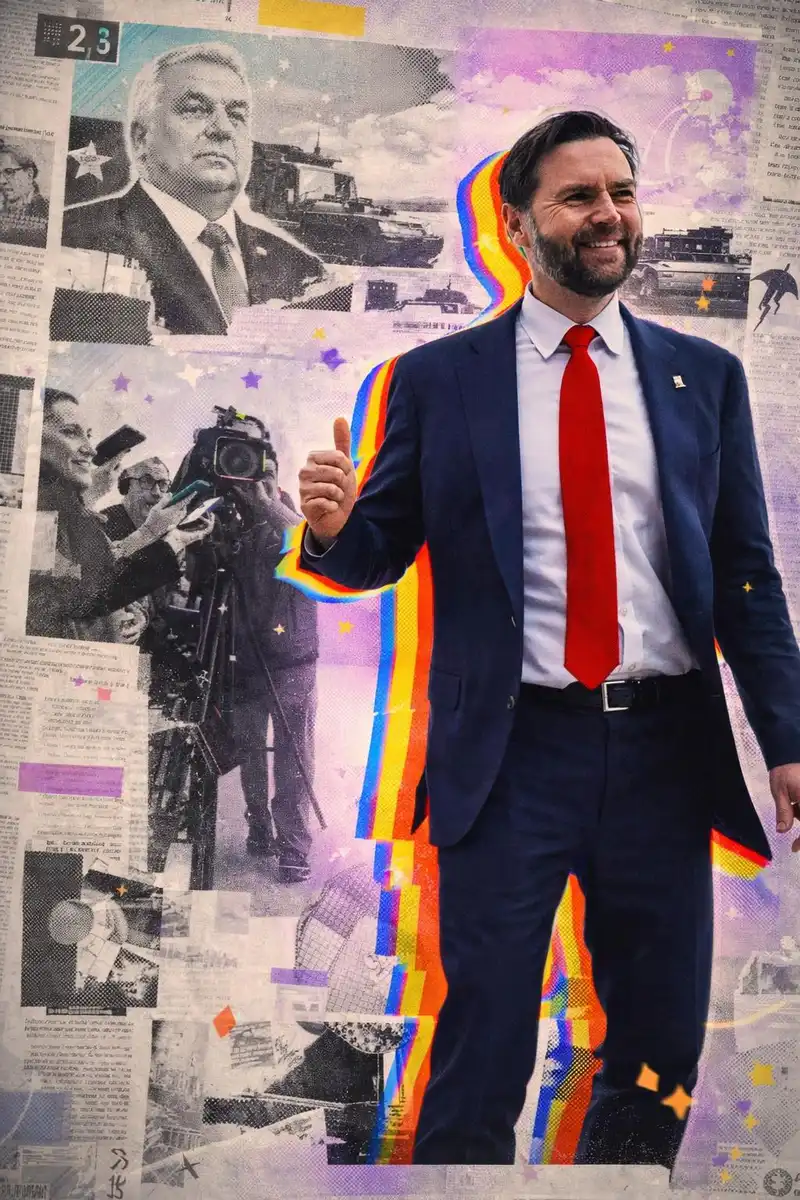
Hungary’s election turns into an argument with half of the Western world
In the final stretch before Sunday’s election, Hungary’s political battle has spilled far beyond its own borders. JD Vance has attacked what he called Brussels “bureaucrats” for meddling in Hungarian politics, while Viktor Orbán’s rival says the White House has also crossed the line. A tidy little reminder that, in Budapest, foreign interference is something everyone sees clearly when it comes from the other side.
The latest reporting on Orbán has not focused on a single campaign stop or one speech. Instead, it has painted a broader picture of a prime minister who has spent years building a political system that is difficult to dislodge, even before the ballots are counted.
A state built to resist a смена of power
One of the central questions around this election is what happens if Orbán loses. That is not just a theoretical exercise. According to reporting published on Apr 3, the current leader has placed loyalists in key public institutions, giving them the ability to obstruct the budgets and legislation of any new prime minister.
That matters because elections do not end when the votes are counted. In Hungary, they may only begin the next phase of the argument.
Why opponents call the contest unfair
Critics have long argued that Orbán’s advantage is not limited to campaign strategy. In coverage published on Apr 1, rivals said his control over the state and much of the media allows him to shape the political environment in his favor.
That does not mean the outcome is predetermined. It does mean the competition starts on an uneven field, which is usually not ideal for the people pretending it is a normal contest.
From liberal dissident to MAGA darling
Orbán’s trajectory is the other major thread running through the recent reporting. On Mar 30, coverage described his transformation from a liberal dissident into a MAGA favorite, and from there into a leader who has pulled Budapest back into Moscow’s orbit.
That shift has helped make him one of Vladimir Putin’s closest friends inside the European Union, a distinction few leaders would put on a campaign flyer. It also explains why Orbán has become useful to parts of the American right, where his brand of nationalism and institutional hardball has found an audience.
The result is a strange political triangle: Brussels is accused of meddling, Washington is accused of meddling, and Orbán is still trying to sell himself as the defender of Hungarian sovereignty.
The bigger picture
Taken together, the reporting from Mar 30 through Apr 7 shows a leader who is not only fighting an election, but also trying to survive its aftermath. The domestic machinery he has built, the media environment around him, and his allies abroad all point in the same direction: Orbán is preparing for a contest in which losing would not necessarily mean leaving the stage.
That is why this election matters beyond Hungary. It is not just a vote on one man. It is also a test of whether a system designed to protect him can outlast the voters who are supposed to judge him.