Quick version: The US and Israel continue strikes on Iran while talk of negotiations circulates. Missiles and drones have hit targets in Iran, Israel and Gulf states. The fighting is rattling energy markets and prompting military moves and emergency measures across several countries.
In Iran
- Attacks and casualties: Bombardments continue. A recent strike in southern Tehran killed at least 12 people and wounded 28. Explosions in eastern Tehran reportedly damaged a school and several homes.
- Talks or talk: The US has said negotiations with Iran are under way and claimed Tehran agreed not to pursue nuclear weapons. Separate reporting says Washington offered a 15-point plan, reportedly helped by Pakistan’s army chief. Iran has denied any change in its stated position on nuclear weapons.
- Historical context: Iran has long said it does not seek nuclear weapons. Iranian leaders have repeatedly made this claim, and a religious ruling against nuclear arms was issued in 2003 by the former supreme leader.
- Domestic confusion: Ordinary Iranians are reportedly confused by claims of diplomacy while air raids, missile launches and air defences remain visible on the ground.
- Tehran’s aim: Analysts say Iran wants to end the war on terms that preserve its deterrence so hostilities do not restart quickly.
- Hormuz navigation: Iranian authorities told the International Maritime Organization that non-hostile vessels may transit the Strait of Hormuz.
War diplomacy
- Pakistan offers to host talks: Islamabad said it is willing to host negotiations to try to stop the fighting.
- Calls for talks: China and France have both urged diplomatic engagement, with public appeals for talking over fighting.
In the Gulf
- Kuwait airport fire: A drone strike hit a fuel tank at the international airport, causing a fire. Authorities say damage was limited to property and there were no casualties.
- Saudi air defences active: Saudi forces reported shooting down at least 32 drones and one ballistic missile in the eastern region, which hosts many of the kingdom’s largest oil facilities.
- Casualty in Bahrain: An attack in Bahrain reportedly killed a Moroccan civilian working with UAE forces.
In the United States
- Negotiation claims: US officials have described a potential deal and have suggested Iran offered a ``present'' tied to the Strait of Hormuz and energy issues. These statements have been framed as positive diplomatic signs.
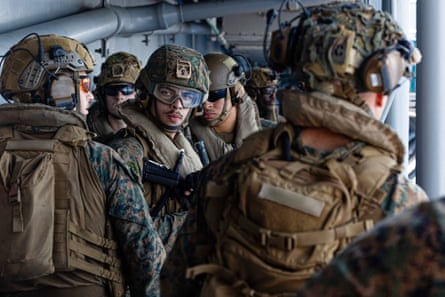
- Troop movements: The US plans to deploy roughly 3,000 soldiers from the 82nd Airborne Division to the Middle East to support operations related to the conflict.
- Sanctions and oil: Washington has eased some restrictions on Iranian oil amid global supply pressures. Some economists warn this could weaken the wider sanctions regime.
In Israel
- Missile alerts: Israel’s military warned of missiles fired toward the country and reported active anti-missile systems after multiple alerts.
- Security zone plan: Israel announced it will take control of an area up to 30 km into Lebanon as a security zone while pressing operations against Iran-backed groups.
- Separate diplomatic track: Israeli officials say they are not part of the US-Iran talks and that military action will continue until Iran’s nuclear and missile capabilities are removed.
In Lebanon and Iraq
- Human cost in Lebanon: Lebanese health authorities report at least 1,072 dead and nearly 3,000 wounded since the escalation began on March 2. Dozens of deaths were recorded in the latest day.
- Ground invasion fears: Lebanese officials warn Israel may mount a ground offensive south of the Litani River. Israel has ordered mass evacuations in Beirut’s southern suburbs as it intensifies strikes on Hezbollah.
- Hezbollah response: Hezbollah says it is striking Israeli soldiers and infrastructure in southern Lebanon and the occupied Golan Heights with rockets, artillery and drones.
- Iraq’s balancing act: Iraq is caught between US and Iranian pressures. After a suspected US strike on a paramilitary base in Anbar killed 15 people, Baghdad granted Iran-backed groups the right to respond to US attacks. Iraq has summoned both the US charge d’affaires and the Iranian ambassador over recent deadly strikes.
- Attacks on US interests: A militia group in Iraq says it launched multiple operations against what it described as enemy bases in the past day.
Oil, energy markets and the Strait of Hormuz
- Market ripple effects: The fighting and threats to shipping in the Gulf are disrupting supplies of key commodities, including helium and fertiliser, and causing price volatility.
- Short-term energy measures: Analysts warn that appeals to ration fuel or work from home could be the start of more formal measures as countries try to reduce immediate dependence on complex fossil fuel supply chains.
- National measures abroad: Sri Lanka ordered street lights and billboard lighting to be switched off to cut energy use by 25 percent. The Philippines declared a national energy emergency amid rising fuel prices and supply concerns.
Takeaway: The conflict remains a mix of active strikes, missile exchanges and diplomatic signals. Even if negotiations are emerging in public statements, the reality on the ground is continued violence, military moves and growing pressure on global energy supplies.