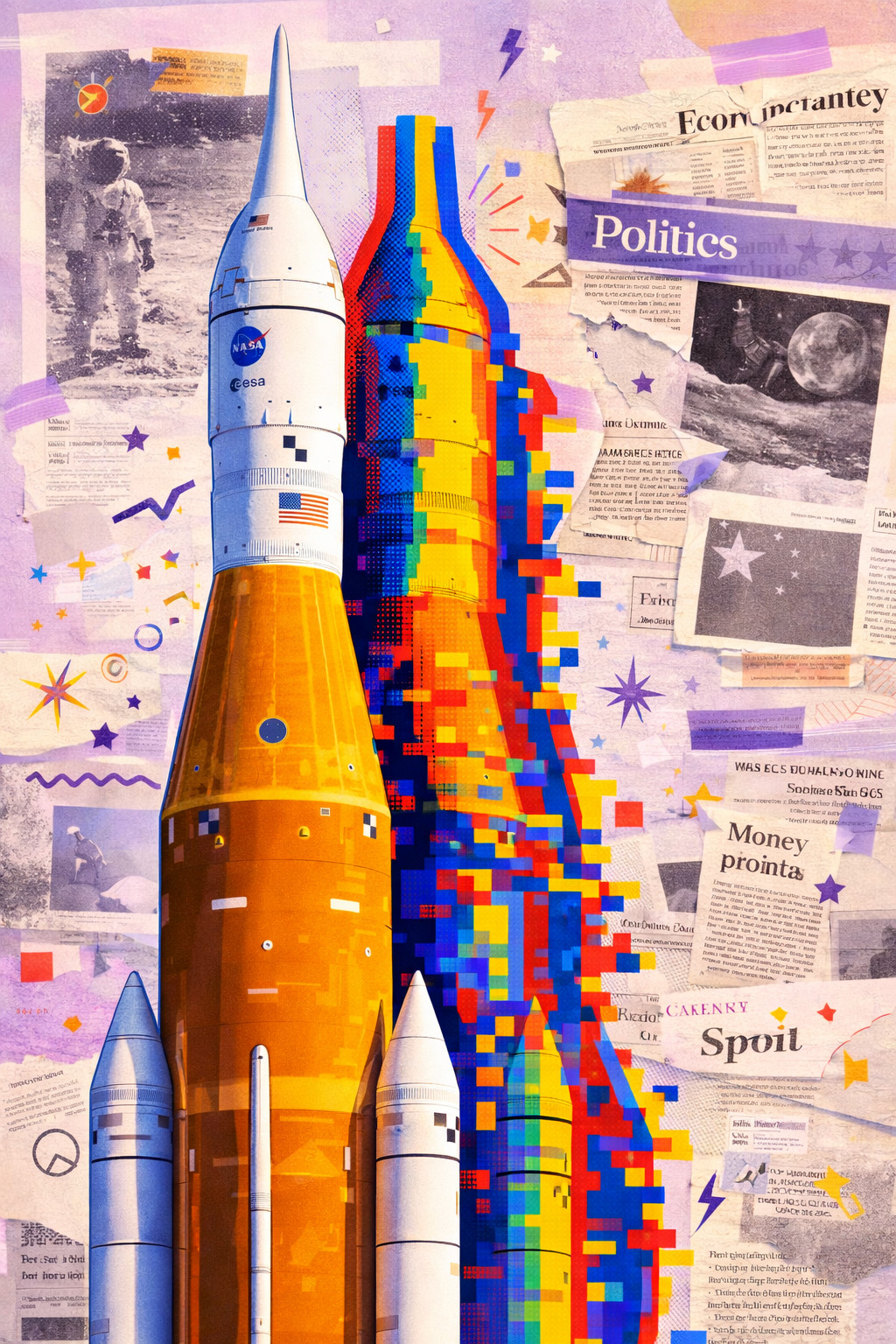
A return to the moon, with bigger ambitions
Four NASA astronauts are scheduled to launch from Florida on Wednesday evening for a historic flyby around the far side of the moon. If the mission goes as planned, it will be the first time humans have traveled to the lunar neighborhood since Apollo 17 wrapped up in 1972.
That alone would be enough to draw attention. But Artemis II is doing more than revisiting old territory. It is part of NASA’s much larger Artemis program, a decade-long effort that is supposed to send humans back to the moon’s surface by 2028 and lay the groundwork for operations that could eventually support Mars missions.
Artemis II itself cost about $4 billion. The broader return-to-the-moon effort carries a price tag of $93 billion. Which is the sort of number that makes even space enthusiasts pause for a moment before continuing with the pitch.
Why go back at all?
NASA’s new administrator, Jared Isaacman, said the answer is not nostalgia.
“The Artemis program picks up where Apollo left off,” he said in an interview on The Conversation podcast. “Not to return to the moon, to plant the flag and pick up the rocks again, but to build an enduring presence, to build a moon base so we can realize the scientific and economic value of being on the lunar surface.”
That is the core idea behind Artemis: not a one-off visit, but a sustained presence. If the 10-day Artemis II flight succeeds, NASA plans to move toward a crewed landing mission in 2027 that will test the commercial spacecraft needed to put astronauts on the moon. Those vehicles would come from SpaceX and Blue Origin.
The longer-term plan is to establish a lunar base by the 2030s. NASA says that base would be powered by nuclear energy and would help secure U.S. leadership in spaceflight and exploration. It also sounds, at least on paper, like the kind of project that makes people in boardrooms and policy shops say “strategic” a lot.
The moon as a test site for Mars
NASA and its supporters argue the moon is not just the destination. It is the proving ground.
Retired astronaut and aerospace engineering professor Dr. Bonnie Dunbar said in a statement shared with The Independent that Artemis is “not just a return to the moon, but a gateway to living and working on another world.” She added: “We’re advancing science, testing technology and forging the path to Mars.”
That logic is part science, part logistics. Launching from the moon makes sense because the lunar surface has far less gravity than Earth, according to National History Museum planetary scientist Professor Sara Russell.
NASA also says the moon itself is a record keeper. The agency argues it contains 4.5 billion years of history that could help scientists learn more about Earth’s evolution, the solar system and cosmic rays from across the galaxy. The lunar South Pole, where NASA hopes to build a base, is especially interesting. NASA says it includes some of the oldest parts of the moon, as well as the margins of South-Pole Aitken Basin, the largest and oldest impact basin in the solar system.
Science, business and the race with China
The Artemis plan is also tied to the commercial space sector. NASA has said it will use more commercially produced hardware in future missions and lunar landings, with landings initially targeted every six months and the option to increase that pace as capabilities improve.
That approach is meant to speed things up and lower costs for the government. It is also a quiet acknowledgment that the government does not want to do all of this alone.
Isaacman has said the mission is also about U.S. leadership in space. The competition is not subtle. China’s space agency plans to send astronauts to the moon by 2030 and has made major progress on its rocket and lander over the past year.
As Scott Pace, director of George Washington University’s Space Policy Institute, previously told The Conversation Weekly podcast: “Rules are made by people who show up.”
Isaacman put the pressure even more plainly, saying the outcome of what he called “this great-power competition” is “measured in months, not years.” He added in a statement:
“If we concentrate NASA’s extraordinary resources on the objectives of the National Space Policy, clear away needless obstacles that impede progress, and unleash the workforce and industrial might of our nation and partners, then returning to the moon and building a base will seem pale in comparison to what we will be capable of accomplishing in the years ahead.”
That urgency is one reason NASA recently said it would delay construction of the lunar space station known as Gateway and focus instead on “infrastructure that enables sustained surface operations.” In plain English, the agency is choosing the part that gets boots on the ground first.
More than geopolitics
There is also a human milestone element to Artemis II. The crew includes NASA commander Reid Wiseman, mission specialist Christina Koch, NASA pilot Victor Glover and Canadian Space Agency astronaut Jeremy Hansen.
If the mission succeeds, Koch is expected to become the first woman to journey to the moon, and Glover would become the first Black man to do so. Hansen would become the first non-U.S. citizen to achieve the feat.
“It feels like an incredible privilege and responsibility,” Koch told Space.com.
That makes Artemis II part science mission, part national project, part diversity milestone. A lot is riding on one trip around the moon, which is a fairly routine concept only in the way that none of this is actually routine.
The costs, and the concerns
Not everyone is eager to celebrate every piece of the Artemis plan.
There are environmental concerns about human activity on the lunar surface. Closer to home, space already has a trash problem. Companies and agencies have helped fill low-Earth orbit, where the International Space Station operates, with thousands of satellites and a growing amount of debris that could threaten future missions or collide with one another.
And then there is the money.
The billions spent on Artemis could go toward other urgent problems on Earth, including climate change. A recent Stanford University assessment said U.S. greenhouse gas emissions since 1990 have caused more than $10 trillion in global economic damages. Rocket launches also add pollution to Earth’s atmosphere, including carbon emissions that contribute to human-caused climate change.
The political backdrop is, as usual, not especially subtle either. The Trump administration and President Trump have labeled climate change a “hoax” and “scam,” and recently revoked the Environmental Protection Agency’s own finding that greenhouse gas emissions from the fossil fuel industry harm human health. States have challenged that in court.
SpaceX founder Elon Musk has argued that the answer to a dying planet is to make humanity a multi-planetary species, although he has since abandoned the idea of a Mars-only strategy. Whether that vision becomes reality is uncertain. It is also not the kind of plan that should be treated as a substitute for fixing the place we already live.
For now, Artemis II is the next step. It is a test of hardware, policy and patience, all in one expensive package. And if NASA gets what it wants, it will be the beginning of something much larger than a lunar flyby.


