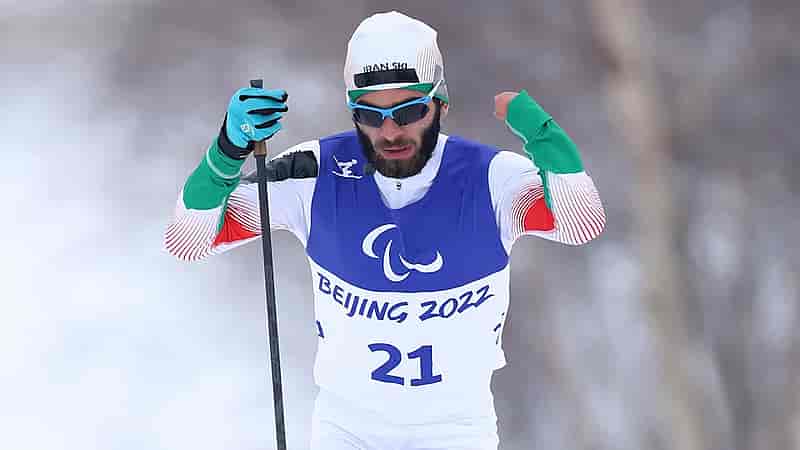
The stage was set in Verona, the opening ceremony just hours away, but for one athlete, the dream of competing at the Milan-Cortina Winter Paralympics has been abruptly halted. The International Paralympic Committee (IPC) announced on Friday that Iran will not participate in the Games, citing that its solitary representative, cross-country skier Aboulfazl Khatibi Mianaei, "cannot travel safely to Italy" due to the ongoing conflict in the Middle East.
This decision underscores how geopolitical tensions can shatter personal aspirations in the world of sports. IPC President Andrew Parsons expressed deep disappointment, stating it was "really disappointing for world sport and especially for Aboulfazl" that he would be unable to take part. Parsons revealed that since the conflict escalated last Saturday, the IPC and the Milan-Cortina 2026 organizing committee had been working tirelessly behind the scenes with Iran's National Paralympic Committee and national ski federation to find alternative routes for the delegation's safe passage. However, with the conflict ongoing across the region, the risk to human life was deemed too high.
The Middle East has been plunged into crisis following joint US-Israeli attacks on Iran, targeting missile infrastructure, military sites, and leadership. In response, Tehran has launched strikes across the region, including on Israel. Residents in Tehran reported experiencing the "worst night" of Israeli strikes so far, with the US indicating that attacks are set to intensify. Additional strikes were launched on Beirut, Lebanon overnight, while Gulf nations like Saudi Arabia, Qatar, and Bahrain reported intercepting Iranian attacks.
Parsons noted that dialogue with Iran's sporting federations had "not been easy," with "communication systems down" across much of the country. He added, "To not compete at a Paralympic Winter Games because of factors outside of his control after years of training and dedication is heart-breaking for the athlete and our sympathies are with Aboulfazl at this difficult time."
For Aboulfazl Khatibi Mianaei, a 23-year-old who has competed at the past two Winter Paralympics in Pyeongchang 2018 and Beijing 2022, this withdrawal represents a profound personal setback. He was scheduled to race in the men's sprint classic standing on Tuesday and the men's 10km interval start classic standing a day later. The emotional weight of this moment is palpable—imagine dedicating years to a singular goal, only to have it vanish due to circumstances far beyond your control. It's a stark reminder that in sports, as in life, the human spirit often contends with forces larger than itself.
This incident highlights the delicate balance between athletic ambition and global safety. While the Paralympics aim to celebrate resilience and inclusivity, they cannot operate in a vacuum, immune to the world's conflicts. The IPC's decision, though difficult, prioritizes human life over competition, a principle that resonates deeply in times of crisis.
As the Games proceed without Iran, the absence of Aboulfazl Khatibi Mianaei will be felt not just as a statistical gap, but as a poignant story of what might have been. It serves as a sobering reflection on how international events can become entangled with broader struggles, leaving individual dreams in the balance.